
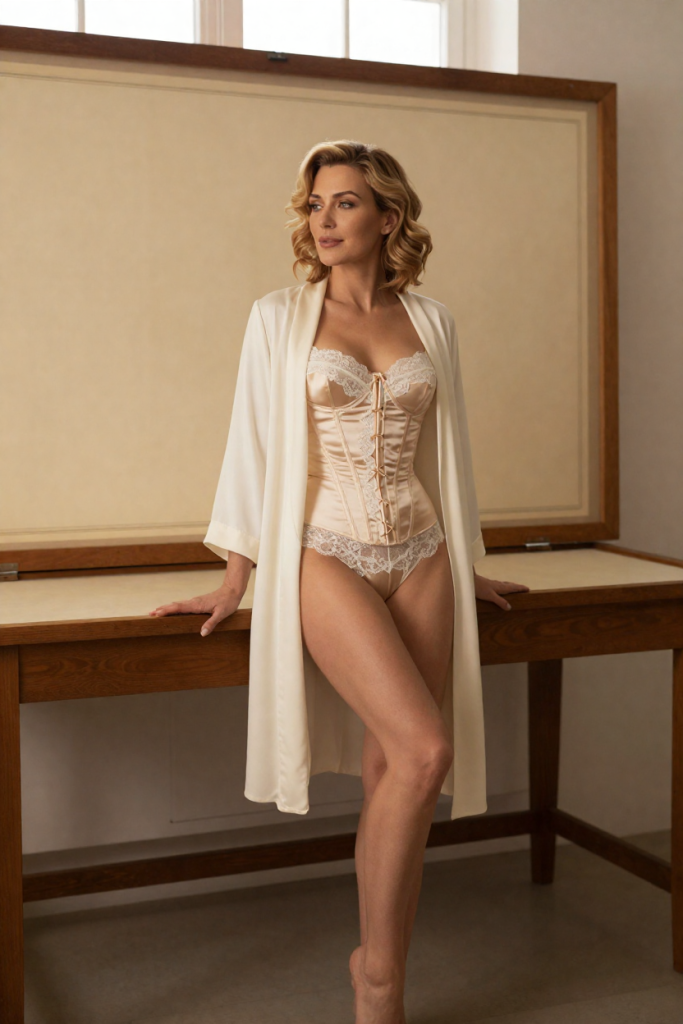
A good brief is a short contract between you and the bench: subject, outfit, setting, light. This note walks the order we use in the studio and shows why one change at a time keeps a set of portraits feeling like one sitting.
At BnbChainMap the work happens at a map-room studio where a plain wooden map case holds smooth blank vellum sheets beside the posing desk, and the same discipline applies as anywhere in the studio: describe clearly, change one thing at a time, and check the result before you build on it. The house muses — Odette and Radka — were built exactly this way, one brief at a time.
Start with the subject
Every strong piece starts with a person, not a mood. Fix the muse first — her age, her hair, the outfit she is known by — and let everything else be scenery. When the subject is stable, the setting can change around her without the set falling apart.
Change one thing at a time
Two changes in one job means two chances to lose what you liked. Run the first change, look at it properly, then run the second on the result you kept. It feels slower for one frame and is faster by the fifth.
Use the house tools
The generator makes the frame, the editor revises it, and the video bench moves it. A standard frame costs 6 credits — and your daily check-in covers exactly one, so experiments can be a daily habit rather than a special occasion.
Keep notes on what worked. A brief that produced a muse you love is worth more than the credits it cost: it is the first line of the next one.